
A Real Life Lesson On Freeze, Flight, and Fight
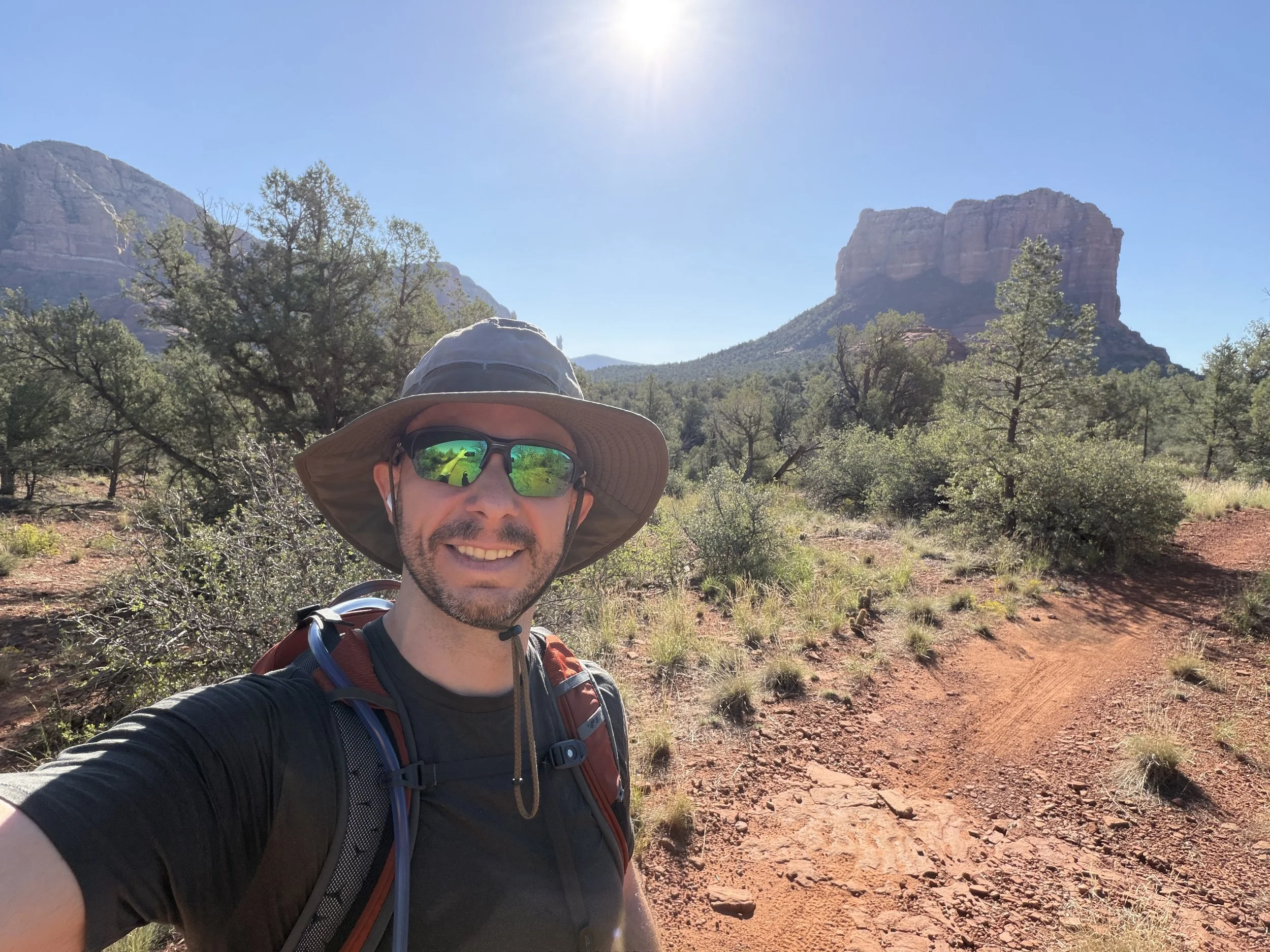
Mike in Sedona
Something moved in the bushes…
I stopped.
I was about five miles deep into the desert outside Sedona, hiking alone, with nobody else around.
A second earlier, I was looking at the scenery and thinking about the trail.
Then I heard rustling in the brush.
Immediately, my attention narrowed.
I oriented toward the sound. My head turned in its direction. My eyes began searching the bushes for movement. My body became still.
And for a few seconds, almost everything else disappeared.
I never figured out what it was.
But the experience made me think about something I teach all the time:
The body can begin responding before we consciously understand what we are responding to.
The Body Responds to the Unexpected
When something suddenly changes in our environment, one of the first things we may experience is an orienting response.
Something happened.
The body turns toward it.
Attention shifts.
The eyes search for more information.
This is an automatic way of answering a very basic question:
What was that?
My pupils may have dilated as well.
Pupil dilation isn't just about light. Our pupils can also enlarge when arousal and mental effort increase. When something suddenly becomes important, the nervous system can increase alertness and prepare us to gather more information.
That is why pupil changes can sometimes accompany surprise, fear, interest, or intense concentration.
But context matters.
Dilated pupils don't tell us why someone is aroused. They simply may be one clue that something has changed internally.
The Limbic System Gets Involved
This is also where the limbic system becomes relevant.
The limbic system is heavily involved in emotion, threat detection, memory, and survival-related responses.
It doesn't wait for us to sit down and logically analyze every detail first.
Something unexpected happens, and the body can begin preparing before our conscious thinking has fully caught up.
That is part of the reason someone can physically react to a sound, movement, facial expression, or change in tone before they can even explain why it caught their attention.
The response comes first.
The explanation may come later.
Then I Froze
One of the most noticeable things I did was stop moving.
That's the freeze part of fight, flight, or freeze.
We sometimes picture freezing as someone being so terrified that they physically cannot move.
It doesn't always look like that.
Freeze can be a brief moment of stillness while the nervous system gathers information.
Movement decreases.
Attention narrows.
The eyes search.
The body prepares for whatever needs to happen next.
In my case, my system didn't yet know whether the noise represented absolutely nothing—or something I needed to respond to.
If a rattlesnake had suddenly appeared on the trail, the response might have shifted toward flight as I created distance from it.
If a coyote had appeared and somehow presented an immediate threat, my body might have prepared me for action.
During fight or flight, the sympathetic nervous system becomes more active.
Heart rate can increase.
Breathing can become faster.
Muscles tense.
Energy becomes available for immediate action.
You do not consciously have to give your body those instructions.
Much of that preparation happens automatically.
And that preparation can become visible through body language.
Physiology Becomes Body Language
This is what makes body language so fascinating.
What we see externally can sometimes be the visible result of something happening internally.
A person becomes suddenly still.
Their eyes widen.
Their pupils change.
Their jaw tightens.
Their hands tense.
Their shoulders rise.
Their breathing changes.
Their feet reposition.
Their body turns toward—or away from—something.
None of those behaviors should be interpreted in isolation.
A tightened jaw doesn't automatically mean anger.
Dilated pupils don't automatically mean attraction.
Crossed arms don't automatically mean defensiveness.
The better question is:
What changed, and what happened immediately before it changed?
That's why understanding someone's baseline is so important.
System 1 Reacts Before System 2 Explains
Daniel Kahneman popularized the idea of System 1 and System 2 thinking.
System 1 is fast, automatic, intuitive, and largely effortless.
System 2 is slower, more deliberate, and analytical.
Out on that trail, I didn't hear the noise and immediately begin logically analyzing every possible animal that might have caused it.
My fast, automatic system responded first.
Stop. Look. Pay attention.
Then the slower thinking began.
Could it be a snake?
A bird?
A rabbit?
A coyote?
Nothing at all?
That sequence matters.
In many situations, people respond first and explain second.
And you can sometimes see that transition in their body language.
Novelty Creates Focus
The noise in those bushes did something else.
It broke the pattern.
For miles, the environment had been relatively predictable.
Walking.
Rocks.
Cactus.
Trail.
Desert.
Then suddenly:
Something moved.
Novelty demanded attention.
The same principle applies to human communication.
People are constantly predicting what is going to happen next.
They recognize patterns.
A salesperson introduces themselves.
A presentation begins.
Someone starts another familiar pitch.
System 1 recognizes the pattern and may begin operating on autopilot.
Then you do something unexpected.
Ask a question they weren't expecting.
Change your tone.
Stop talking when they expect you to continue.
Say something that doesn't fit the familiar pattern.
You've created a pattern interrupt.
That novelty can pull someone out of automatic processing and force more deliberate attention.
In other words, you may create a moment where System 2 becomes more involved.
Then watch the body.
Do they suddenly look directly at you?
Do they stop moving?
Do they lean forward?
Do their eyes widen?
Does their posture change?
Does their breathing change?
You haven't necessarily persuaded them.
You've done something that has to happen first:
You've captured their attention.
Watch the Change
Instead of constantly asking:
“What does that gesture mean?”
Try asking:
“What just happened that caused their body to change?”
Look for the shift from baseline.
Look at the timing.
Look at the context.
Five miles into the Sedona desert, completely alone, I heard something moving in the bushes.
I never found out what it was.
But my body had already started responding long before I could explain what caused the sound.
And there's one more reason I told the story this way.
Go back to the first sentence:
“Something moved in the bushes.”
I could have started by telling you I went hiking in Sedona.
I could have explained that this article was about body language.
I could have defined the orienting response.
Instead, I gave your brain something unexpected and unresolved.
I broke the normal pattern.
I created a little uncertainty.
And hopefully, you wanted to know what happened next.
I opened this article with a pattern interrupt.
-Mike